Alfvénons, and AI agents on open research problems
←→ to move, F for full screen, N for speaker notes
Caltech C AI Workshop · AI in Academia · November 21, 2026
Alfvénons, and AI agents on open research problems
An exact large-amplitude wave for the solar wind, built by checking every step. Then: research problems turned into tasks with a grader, so AI agents can climb them.
Zesen Huang · UCLA Earth, Planetary, and Space Sciences
slides.xhelio.ai/caltech-2026
Plan02
Two parts, one idea: a check you can run
Part 1 · physics · 10 min
The Alfvénon
A localized, large-amplitude Alfvén wave that is an exact solution of MHD. Four hard constraints on one 3D field, met by alternating projection, then tested in simulation.
Part 2 · AI · 5 min
ALE Astronomy + OpenRSI
Real research problems turned into tasks: public data, a program to write, a grader on data the agent never saw. Agents climb the score round after round.
"Generation is cheap. Verification is the new bottleneck." In the first part a person did the checking; in the second, the check is built into the task.
Part 1 · Alfvénon · motivation03
The solar wind turns its field, but keeps its strength
Parker Solar Probe sees the field rotate by large angles, even reverse ("switchbacks"), while |B| barely changes.
Velocity is locked to the field: δu = ∓δb. The fluctuations are Alfvénic and run away from the Sun.
They are localized, with uniform field around them, and field lines pass through.
Is there an exact nonlinear MHD solution with all of these, at amplitude δB ~ B₀?
Belcher & Davis 1971 · Goldstein et al. 1974 · Kasper et al. 2019 · sketch, not data
Part 1 · Alfvénon · the equations04
If u₁ = ±b₁ and |b| is constant, the nonlinearity cancels
Incompressible MHD, Alfvén units b = B/√(μ₀ρ)
∂u/∂t = −u·∇u + b·∇b − ∇P* ∂b/∂t = b·∇u − u·∇b
Split b = b₀ + b₁(r, t), u = u₁, with b₁ → 0 far away.
u₁ = ±b₁ ⇒ the quadratic terms cancel exactly
|b| = const ⇒ P* = p + |b|²/2 uniform ⇒ ∇P* = 0
What is left is linear:
∂u₁/∂t = (b₀·∇)b₁, ∂b₁/∂t = (b₀·∇)u₁
The shape moves along b₀ at the Alfvén speed, unchanged, at any amplitude.
The catch. The initial field must already be divergence-free, have constant |b|, and be localized, all in 3D.
Part 1 · Alfvénon · the hard part05
Four constraints on one 3D vector field
1
|B| = 1
removes the pressure term. Pointwise, nonconvex.
2
∇·B = 0
a real magnetic field. Global, linear.
3
Open lines
field lines enter and leave the box, like the wind's.
4
Solitary
b₁ → 0 far away: uniform outside.
Each one alone is easy. All four together, genuinely 3D, is the problem: find a point in the intersection of a linear subspace and a curved, nonconvex set.
Part 1 · Alfvénon · the construction06
Enforce ∇·B = 0, then |B| = 1, and repeat
Project onto divergence-free fields: a Helmholtz projection, one FFT.
Rescale each point: B → B/|B|.
Repeat until both errors are small.
Bound. The set is nonconvex: convergence is shown for this construction, not guaranteed for any seed.
Cartoon of the idea in 2D · not the paper's geometry or iteration path
Part 1 · Alfvénon · the check07
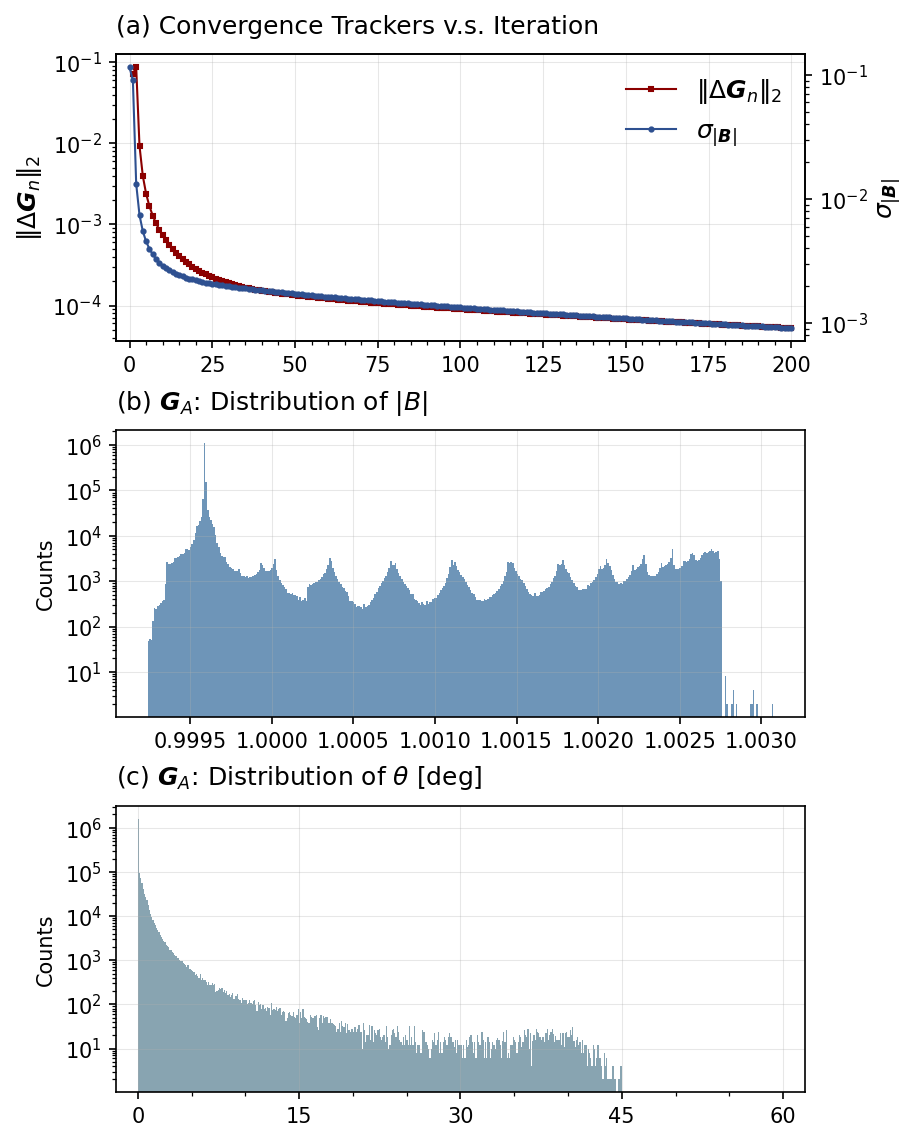
It converges, and the result is a localized twist
~200iterations: both error trackers fall
0.999–1.003range of |B| over the box
≈ 45°peak rotation; θ ≈ 0 outside: uniform, open field
Huang, Velli, Shi & Ding 2026, ApJL · arXiv:2512.02292 · Figs. 2 and 3
Part 1 · Alfvénon · in 3D08
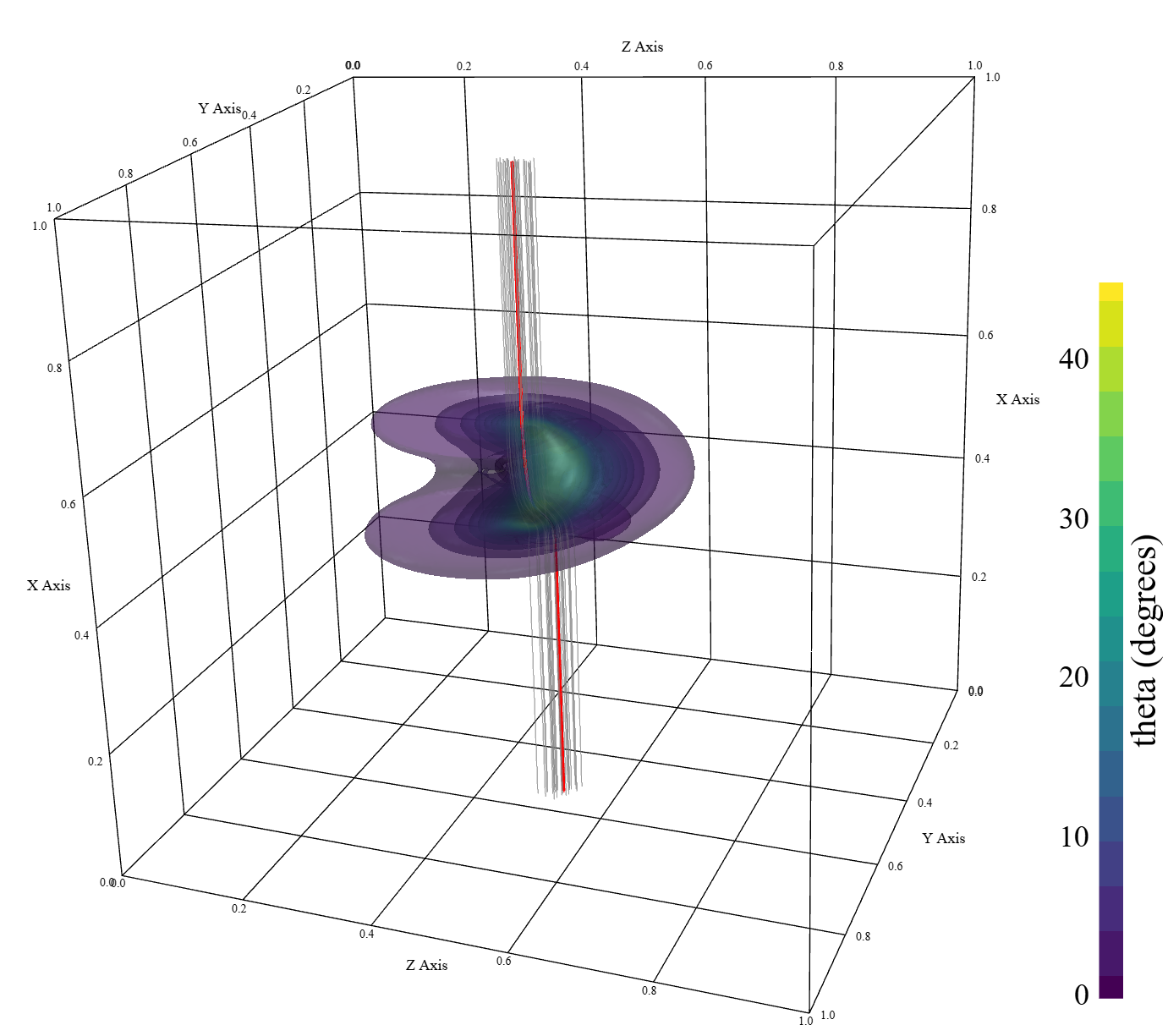
The constructed field in 3D
Field lines come in uniform, twist through the structure, and leave uniform.
Camera move around a static field: geometry, not propagation.
Part 1 · Alfvénon · the test09
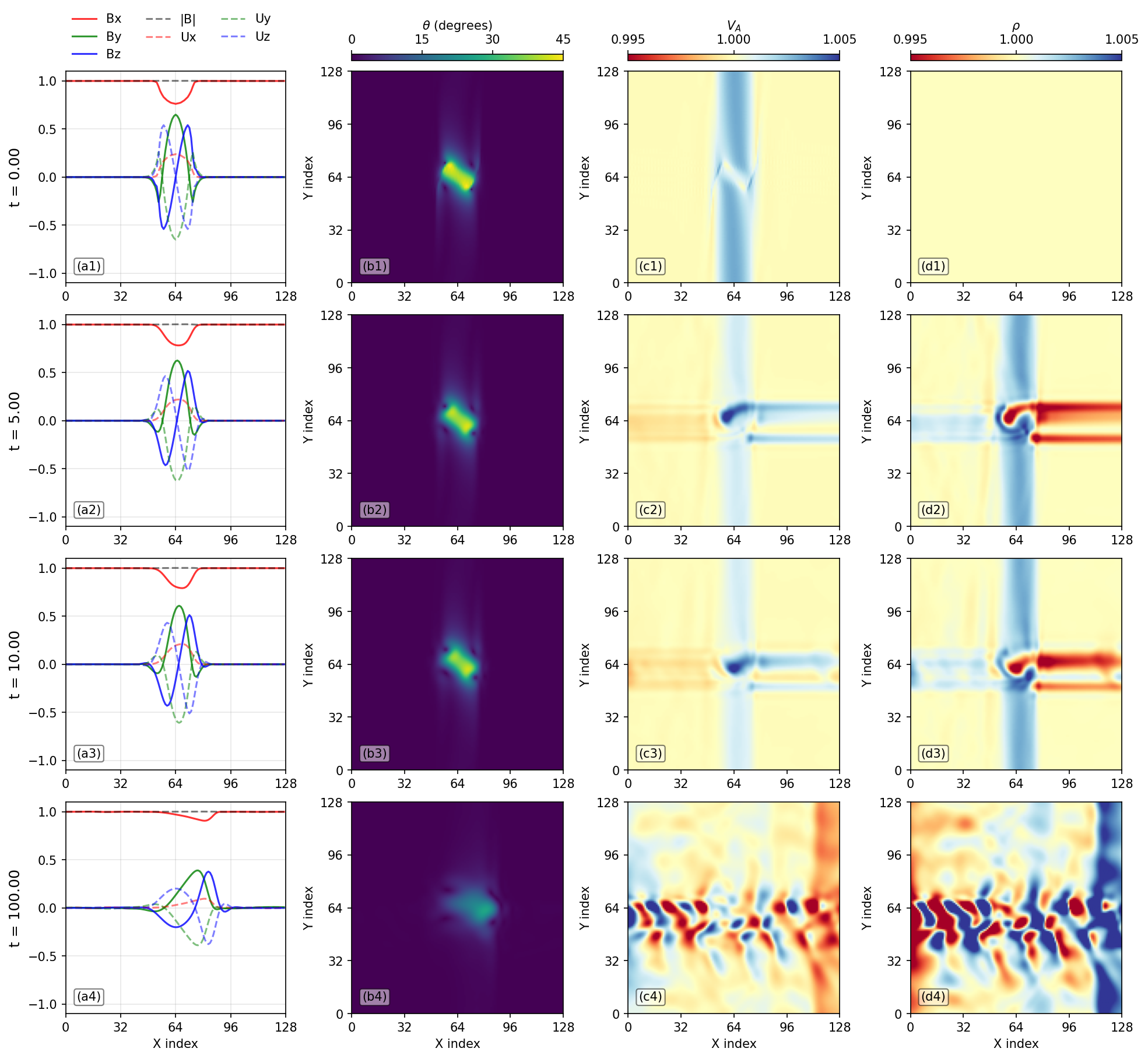
Run it in MHD: the structure keeps its shape
|B| stays flat while the components swing.
Density and Alfvén speed move within ±0.5%.
Coherent to t = 10; still |B| ≈ 1 at t = 100, with visible evolution.
Bound. Finite-time numerical evidence of coherent propagation, not a stability theorem.
Part 1 · Alfvénon · work in progress10
Now collide two: they cannot be superposed
|b₀ + b₊ + b₋|² ≠ const: the cross term 2b₊·b₋ appears where they overlap
A magnetic-pressure imbalance in the overlap launches magnetosonic (compressive) waves.
Each Alfvénon alone has δ|B| ≈ 0, δρ ≈ 0, so all compressive energy comes from the collision.
Estimate: energy ~ (δb/B₀)² × Alfvénic energy: order one when δb ~ B₀.
Huang et al., in preparation. Early float64 3D runs conserve energy to ~10⁻⁸; conversion grows with amplitude. Matched controls and an amplitude scan come next. Not yet a result.
Bridge11
Every claim had a check you could run
Claim
Check
The field is divergence-free
∇·B residual, every iteration
|B| is constant
spread of |B|: 0.999 to 1.003
It propagates as a solution
MHD runs to t = 100
Collisions make compressive waves
energy conserved to ~10⁻⁸, then the budget
AI tools helped with this work (the paper says so). The checks decided what was true. So: give agents research problems that come with the check built in.
Part 2 · ALE Astronomy12
ALE Astronomy: research problems become gradable tasks
1 · A problem
A researcher describes what they want advanced, usually in a short call.
→
2 · A task
Public data, a program to write, and a grader that scores it on data it never saw.
→
3 · A climb
Agents write a program, get a score, and try again, round after round.
1,779open problems harvested from the literature
891seeds: problems judged as possible tasks
59task cards for experts to iterate
71research directions in 7 fields, Earth to cosmology
The astronomy track of Agents' Last Exam (led by UC Berkeley), with OpenRSI Astronomy. The researcher reviews the task before any agent runs, and any scientific result belongs to the researcher.
Part 2 · the tasks13
Three kinds of task: find, model, speed up
Find
Large distant bodies in 13 years of DECam images running
Intermediate-mass black holes, or glitches? in gravitational-wave data
Transients from light curves alone, for Rubin
Eclipses vs. everything else in space photometry
Model
After a neutron-star merger: a fast surrogate from a few hundred simulations
Type Ia supernovae: a better standardization for distances
Spectra from images: stellar mass, dust, star formation
Predict the next instrument from an older one's sparse data
Speed up
Black-hole binaries: adaptive-mesh relativity on four GPUs
Radiation transport for accretion discs
TESS full-frame images: same light curves, faster
Space weather: Sun-to-Earth CME forecasts
Each one: public data or a simulation, a program to write, one number from a sealed grader. Shaped with researchers in each field.
Part 2 · a task that climbs14
Finding large distant bodies in 13 years of DECam images
246 Mdetections in the four test regions, public DECam archive, 2013–2026
30 minof one GPU per sky region
The known bodies are the answer key. Whatever else a program finds with confidence is a lead.
Part 2 · verification15
A lead is not a discovery until it is checked
The lead
A body in the DECam archive matching nothing in the Minor Planet Center's files: a 7-year arc, about 44 au, roughly 65–150 km.
Independent check
Found at the predicted spot in 68 of 68 archival CFHT images, 23 nights, never used for the orbit. Known bodies recovered as a control.
Status
Reported to the Minor Planet Center in November 2026, awaiting review.
And the other side. 18 later high-confidence leads were all false when checked against static sources and per-exposure consistency. The check is what made the one real.
Part 2 · OpenRSI Index16
OpenRSI Index: can agents improve themselves on real research?
An open effort to measure whether AI agents can drive recursive self-improvement and extend the frontier, not just reproduce known results or sweep parameters.
Tasks from one GPU to 256 H100s: post-training a 122B model, an optimizer for a scaling ladder, an H100 GEMM kernel, and now astronomy.
Open tasks and open execution logs.
An agent pipeline builds a new task from your idea in about an hour; accepted contributors become co-authors.
What a scientist brings
A problem where a better answer can be told from a worse one, on data the agent never sees.
That is the whole interface. The agents bring the generation.
index.openrsi.foundation · ALE Astronomy builds OpenRSI Astronomy
Part 2 · what makes a good task17
What makes a problem a good task
1 Verifiable
A better result can be told from a worse one: later observations, held-back cases, or a simulation with known truth. Nobody needs to know the answer.
2 One metric
One number with a direction, and an expert agrees the better-scored method is better.
3 Something to optimize
A detector, fitter, solver, emulator or search, not one fixed answer a single known step finds.
4 Open-ended
Better methods keep scoring better: far from any ceiling, or no ceiling at all.
5 An honest grader
No lookahead; the agent answers with a program, run on sealed data under a fixed budget.
Thank you · questions welcome
Generation is cheap. Bring the check.
Alfvénon
An exact, localized, constant-|B| Alfvén wave, built by alternating projection and tested in MHD. Collisions: in progress.
arXiv:2512.02292 · ApJL 2026
ALE Astronomy + OpenRSI
Your research problem plus a grader becomes a task agents can climb. The results stay yours.